
About the Project and the Involvement Opportunity
Heart disease is a leading cause of death for women in WA and globally. However, women are often under diagnosed and experience worse outcomes after heart attacks than men. This happens because heart disease in women is biologically unique. Instead of massive blockages, women frequently suffer heart attacks from subtle surface erosion inside smaller blood vessels.
Current scanning tools rely on basic black-and-white images. These scans are prone to shadowing artefacts and often miss the specific tissue composition changes and small surface clots that trigger heart attacks in women.
Our project aims to address this problem by developing a very small heart imaging catheter. The catheter uses advanced light-based technology to examine the inside of blood vessels in much greater detail. Instead of using chemical dyes, it measures how light interacts with the vessel wall to create detailed 3D images that show the makeup of the tissue.
Because the catheter is so incredibly small, it safely navigates the narrower blood vessels typical in women. Moreover, this technology allows doctors to clearly tell the difference between healthy tissue, dangerous fat deposits, hidden calcium, and the exact surface erosion patterns responsible for female heart attacks. Over this four-year project, we will test this device using donated human tissue and large animal trials in WA. By removing diagnostic guesswork, this technology could help doctors diagnose women sooner, choose the right treatment more quickly, and improve heart health outcomes for women across metropolitan, regional, and First Nations communities in WA.
About the Position
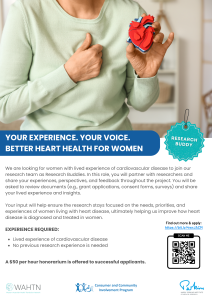
People with lived experience bring valuable perspectives that help ensure research focuses on what matters most to women affected by heart disease. By working together, we can make the research more relevant, accessible, and meaningful, with the goal of improving care and outcomes for women.
- Research Buddy: Partner with the research team throughout the project, providing feedback, guidance, and a lived experience perspective to help shape the research as it progresses.
- Micro Community Conversations: Take part in a small group discussion (around 6 people) to share your experiences and views on specific topics related to the research (optional)
What Am I Expected to Do?
- Review documents (e.g., grant applications, consent forms, surveys)
- Share your lived experience and insights
Optional: Participate in public presentations or forums
What Skills or Experience Do I Need?
Lived experience of cardiovascular disease is the only skill required.
How Long Am I Expected to Be Involved?
We anticipate roughly 2 hours per quarter, for the life of the four year project. This is subject to research buddy and researcher agreement and can be flexible. Additional work throughout the four years may also be required such as emails, document reviews and ad hoc work as agreed upon.
Where Will Meetings Be Held?
A mix of in-person and online, depending on consumer preference
What Support Is Offered?
- An honorarium of $50.00 per hour is available for consumer involvement activities in line with CCIProgram guidelines
- Training and support provided by the CCIProgram or relevant support body.
Note: By checking this box, you agree to allow us to save your details to a cookie on your device. Your information will not be saved to our servers and will only be used to assist in pre-populating your details on other registration forms. You can clear your saved details by removing this cookie through your browser settings.